


Syllabus: GS3/ Energy
Context
- The Union Government has exempted higher ethanol-petrol blends (22%-30% ethanol) from central excise duty and proposed amendments to recognize E85 and E100 fuels under the Central Motor Vehicles Rules.
What is Ethanol?
- Ethanol is 99.9% pure alcohol that can be blended with petrol. It can be produced from sugarcane, maize, wheat, etc which are having high starch content.
- Alcohol production involves fermentation of sugar using yeast. In cane juice or molasses, sugar is present in the form of sucrose that is broken down into glucose and fructose.
Ethanol Blending Programme
- Ethanol blending refers to the practice of mixing ethanol with gasoline to create a fuel mixture that can be used in internal combustion engines.
- The ‘National Policy on Biofuels’ notified by the government in 2018 envisaged an indicative target of 20% ethanol blending in petrol by 2030.
- In 2014 only 1.5 per cent ethanol was blended in petrol in India.
- Given the encouraging performance and various interventions made by the government the 20% target was achieved in 2025.
- The programme has reportedly saved approximately ₹1.13 lakh crore in foreign exchange and reduced nearly 544 lakh metric tonnes of CO₂ emissions cumulatively.
- In June 2026, the government introduced E85 for flex-fuel vehicles; E100 is expected to be offered in the near future too.
Why is India Promoting Higher Ethanol Blends?
- Enhancing Energy Security: India imports nearly 88.5% of its crude oil requirements.
- Greater ethanol blending can reduce dependence on imported petroleum and improve energy resilience.
- It will also reduce foreign exchange outflows and improve macroeconomic stability.
- Supporting Farmers: Ethanol production creates an additional market for sugarcane, maize, and surplus food grains, providing income support to farmers, particularly in states such as Uttar Pradesh and Maharashtra.
- Environmental Benefits: Ethanol is a renewable fuel that emits fewer pollutants compared to conventional petrol and higher blending can contribute to reduced carbon emissions and cleaner transportation.
- Rural Industrialisation: Expansion of distilleries has stimulated rural infrastructure development and generated non-farm employment opportunities.
- Global Biofuel Leadership: India is a founding member of the Global Biofuel Alliance launched during the G20 Summit.
- The programme strengthens India’s role as a global leader in sustainable biofuels.
Initiatives Taken by Government
- National Policy on Biofuels, 2018 (Amended 2022): It expanded eligible feedstocks to include maize, damaged food grains, sugar beet, and surplus rice.
- It reduced dependence on sugarcane as the sole ethanol source.
- Ethanol Procurement Pricing: The government annually notifies ethanol procurement prices for Oil Marketing Companies (OMCs).
- This provides investment certainty to distilleries and income stability to farmers.
- Interest Subvention Scheme: Provides subsidized credit for establishing and expanding distillery capacity.
- Flex-Fuel Vehicle Initiative: The Ministry of Road Transport and Highways has encouraged manufacturers to develop flex-fuel vehicles capable of operating on higher ethanol blends.
- India has launched E85 fuel as part of its long-term strategy to move beyond E20 blending and promote flex-fuel vehicles (FFVs).
- The rollout commences across 48 Public Sector OMC’s retail outlets (ROs) in the country, enabling flex-fuel vehicle users to access this cleaner fuel.
Concerns Regarding Higher Ethanol Blending
- Vehicle Compatibility Issues: Ethanol is highly hygroscopic i.e. it actively absorbs moisture from the atmosphere.
- Higher ethanol blends may damage engine components, fuel lines, rubber seals, and metal parts in vehicles not specifically designed for such fuels.
- Mileage: Ethanol contains lower energy per litre than petrol. The customers had flagged a drop in mileage after the E10 to E20 shift.
- Feedstock Volatility: Sugarcane production remains highly dependent on monsoon conditions. Drought years can disrupt ethanol supply and blending targets.
- Food versus Fuel Debate: Diversion of rice and maize towards ethanol production can raise concerns regarding food security and inflation.
- Blending Compliance: Ensuring uniform blending standards across urban and rural fuel stations remains a logistical challenge.
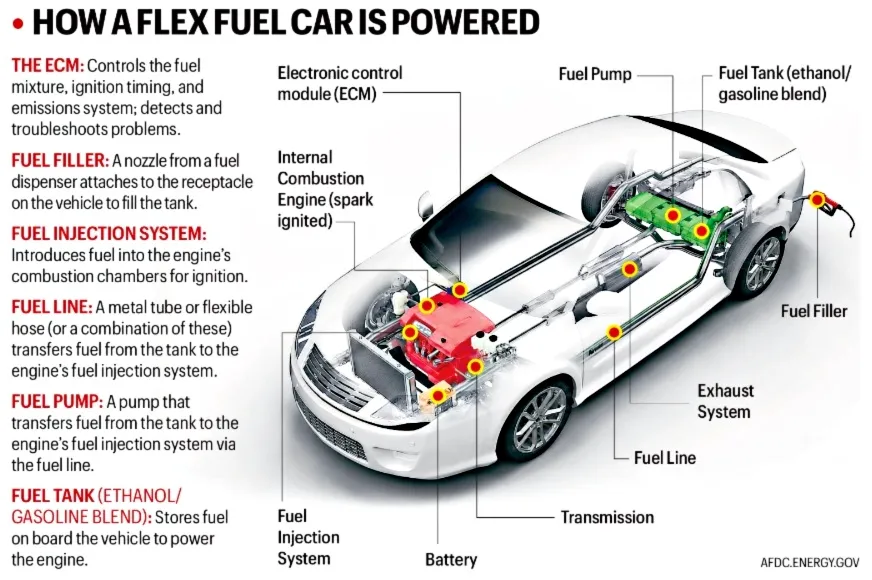
What are Flex-Fuel Vehicles (FFVs)?
- Flex-fuel vehicles are capable of operating on varying blends of petrol and ethanol, including E85 and E100.
- These vehicles use specialized engines and fuel systems designed to withstand high ethanol concentrations.
- India is currently exploring the wider adoption of flex-fuel technology.
Brazil’s Ethanol Programme
- Long-term policy commitment: Brazil launched its ethanol programme in the 1970s in response to global oil market uncertainties and consistently supported it for over five decades.
- Phased Implementation: Brazil gradually expanded ethanol usage over several decades and existing vehicle owners were not adversely affected by sudden policy shifts.
- Consumer choice: At most Brazilian fuel stations, consumers can choose between petrol blended with 27-32% ethanol and E100 (pure hydrous ethanol).
- Promotion of Flex-Fuel Vehicles: Brazil encouraged large-scale adoption of flex-fuel vehicles through supportive policies and industry cooperation.
Way Ahead
- India should adopt a gradual and evidence-based transition towards higher ethanol blends.
- Consumer interests and vehicle compatibility concerns should be adequately addressed.
- Wider adoption of flex-fuel vehicles should be encouraged through incentives and technological support.
- Alternative feedstocks such as agricultural residues and second-generation biofuels should be promoted.
Source: IE
Previous article
India’s Space Economy
Next article
News In Short 15-06-2026
